Author Archives: clientrwanda

Developing A Business Model That Works

The following excerpt is from Scott Duffy’s book Breakthrough.

What’s the first step in figuring out how to execute your big idea? Creating a working model for your business.

We’ve all been brainwashed into thinking that the best way to do this is to sit behind our desks and write a long, detailed business plan. You know the kind: It starts with a fancy cover and your mission statement, then describes your team, market, product, competition, and so on.

Most entrepreneurs spend a lot of time and resources writing their plan. Too often, they get feedback from all the wrong people. Their friends and family want to support them, but they’re telling the entrepreneurs only what they want to hear — that they have come up with the next Google or Apple or Tesla (keep in mind, none of this feedback is coming from customers).

By the time the entrepreneur gets to the last section in the business plan — the financials — he’s totally sold on the idea. Sometimes the financial section is left unfinished or dropped entirely as the business is launched.

And why not? We’re passionate. We’re committed. We know we can’t fail. So what are we waiting for? Let’s go!

Here’s the problem: Most entrepreneurs change their business model six times when working through the financial section of their plans. While running the numbers, they identify key distinctions with regard to income and expenses. They gain a deeper understanding of what it will take to break even and how to achieve free cash flow. As a result, they come up with better-informed strategies for attaining their desired financial outcomes.

The most important part of the initial business planning process, and the one people most often neglect, is getting your numbers to tell a story that makes sense for you and your investors. If you start at the beginning of the plan only to learn that your assumptions about the business don’t add up once you reach the end, you’ve lost valuable time and money.

Regardless of whether you’re in startup or growth mode or moving to the next stage of your business, mistakes can be costly, so here’s what I recommend:

1. Start with the last page first

Once I have a basic understanding of what I’d like to build, the market, my target customers, the busi­ness opportunity, and the product, I dig right into the numbers and create a simple one-page spreadsheet that clearly identifies how the money flows. Basically, I write business plans backward. I’ve learned that once the numbers tell the story you want, the rest of the plan will write itself.

2. Don’t wait

Don’t make this process more difficult than it needs to be. Limit your model to one page. Create the simplest, most basic spreadsheet you can that identifies income, expenses, breakeven, cash flow, and the capital required to achieve your outcome. Use conservative assumptions, and don’t rely on best-case scenarios.

3. Get out of the office

You’ll learn more about your business by getting into the market than you ever will sitting behind a desk. At least 50 percent of your time should be outside the office gathering information that can be applied to your plan. That means contacting industry insiders to learn more about the market, talking to prospective customers about their needs, and testing your competition’s products and services.

4. Be careful who you listen to

When we have an idea we passion­ately believe in, we’re convincing. It’s easy for our family and friends to tell us we have a winner on our hands because they want to be supportive.

But when you’re modeling your busi­ness, the people whose feedback matters most are current and potential customers. Listen to what they have to say and apply what you learn to your model. Let their feedback, and not your enthusiasm, sway your projections.

5. Don’t throw out negative feedback

Sometimes it can be difficult to absorb negative feedback in a constructive frame of mind because we’re so close to our projects and have so much on the line. We start rejecting and deflecting feedback that isn’t in line with what we believe.

But honest, educated feedback is like gold — use it to open your mind and ask tough questions about your assumptions. You must be obsessively committed to asking what you can learn from this feedback and how you can apply it.

This is especially important for people entering new markets where they don’t have prior experience. Getting feedback from others who’ve lived in the space will add to your perspective. Sometimes you’ll learn that there are things you don’t know as a newcomer that would significantly impact your financial results.

In fact, this holds true throughout your business’s lifetime. The entrepreneurs I know who’ve built the most successful and thriving businesses are obsessed with getting constant feedback from the marketplace and adapting their businesses based on evolving market needs.

6. Be open to what the numbers tell you

The worst thing you can do is try to manipulate a model to match your assumptions. You need to approach your financial model with a completely open mind.

Recognise that it will probably take longer than you ini­tially thought to get to market, generate revenue, create profits, and accumulate the cash flow you need to operate and further invest in the business. By being open, you’ll be able to make distinctions, apply them to your business, and set yourself on a path to success.

You need to be clear on where you want to go and put a simple and adaptable plan in place to help you get there. The clearer your vision is upfront, the easier it will be to back a plan to help you get there. Being obsessed with customer feedback will enable you to tweak strategy in a way that evolves with the market and helps keep you on top of the competition.

This article was originally posted on Entrepreneur.com.
BDC Graduate – Mr. Emmanuel Nturanyenabo – selected for the prestigious Tony Elumelu Entrepreneurship Programme (TEEP)

We are always proud of our own graduates who are making it to the high table of Africa’s promising young entrepreneurs; and hereby congratulate our graduate – Mr. Emmanuel Nturanyenabo, MD of Teebah Film Village Ltd, who was recently announced among Africa’s leading young entrepreneurs who will participate in the 2018 edition of the prestigious Tony Elumelu Entrepreneurship Programme.

Mr. Emmanuel can be best described as a natural storyteller who found his life-purpose and passion through media and film-making. Before joining BDC Rwanda where he developed his company, Emmanuel went through several training at local and regional prestigious institutes to gain professional expertise, including: Kwetu Film Institute, Africa Digital Media Academy and Maisha Film Lab. His interest is in Writing, Directing and Producing. He has worked as Props Manager on Mageragere City Drop Out by MBABAZI Aime Philbert that won the best short film in Rwanda Film Festival, and has been selected in other international film events and festivals. He also worked as Script Advisor on Umutoma Feature Film by KWEZI Jean that won the Special Mention at Luxor Film Festival and until now it is still being selected in different international awards. He has also done Sound for two short films, namely “The Female Fighter” by Idriss Gasana Byiringiro and “A Little Skater” by Wilson Misago. Recently, Mr.Emmanuel created and directed a TV Plot called “IKOROSI” that tells a story of romance and land conflict. He wrote and directed the Short movies like “Stereotypes”, “Wooden Pillow”, and many others. His Web Series called “Why’s Book” is the postproduction phase and he has several projects on progress, just to mention a few.



  

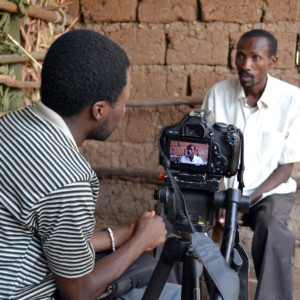
Emmanuel directing “IKOROSI” TV Plot (Left), Emmanuel working on “A Little Skater” as a sound person (Right)

Emmanuel’s motivation to quit his job at CARSA, join the BDC Rwanda, and dedicate his entire time to building his company grew from his passion to contribute to shaping a better Rwanda which enjoys unity, reconciliation, harmony and socio-economic growth of its inhabitants. As Emmanuel affirms, Rwanda’s 1994 genocide left the Rwandan community with struggles of poverty, unemployment, and family conflicts – and all these scenarios create stories. As natural storyteller, Emmanuel founded Teebah Film Village Ltd with the aim to build a full-service video production company that would use storytelling for trauma healing and youth empowerment. Teebah Film Village tell stories of NGOs and social enterprises to maximize their impact in re-building a better Rwanda. These organizations that are tackling these problems, but they struggle to get international awareness and partnerships. Teebah’s turnkey video production gives these organizations a simple and powerful tool to share their work and attract new partners.

A product developed here at the BDC Rwanda, Teebah Film Village Ltd builds Rwanda by sharing the stories of character, heroism, and history. Through this company, Emmanuel strengthens the society through helping Rwandan NGOs and social enterprises gain partners overseas; local job creation and; positively impacting the economy. Business shall also create jobs, and therefore, Teebah Film Village employ contractual people with a variety of vocational skills, including photographers, video editors, cooks, and salespeople. Additionally, the company pays commission to salespeople who have other fulltime jobs, which supplement their income and increase the reach of the business. Speaking to Mr. Emmanuel, he confirmed that Teebah Fim Village plans to hire a fulltime video producer, and looks forward to embark on further new initiatives to encourage networking and story-telling, including a café and studio to host talks and screenings.


Emmanuel live-streaming the investment pitching competition during Rwanda Investment Conference & Expo 2017 (Left); Emmanuel shooting one of his films (Right)

Speaking about his BDC experience, Mr. Emmanuel gives this firm testimony

“Attending BDC Rwanda’s 14-Weeks Entrepreneurship Training was a life changing experience. During the programme, I learnt a lot of things that I immediately applied to make my business idea a reality, even arriving at the point where I decided to change the name of my company. I also managed to strengthen my vision and mission; and most importantly, I learned to understand my market and create the value proposition” says Emmanuel Nturanyenabo.

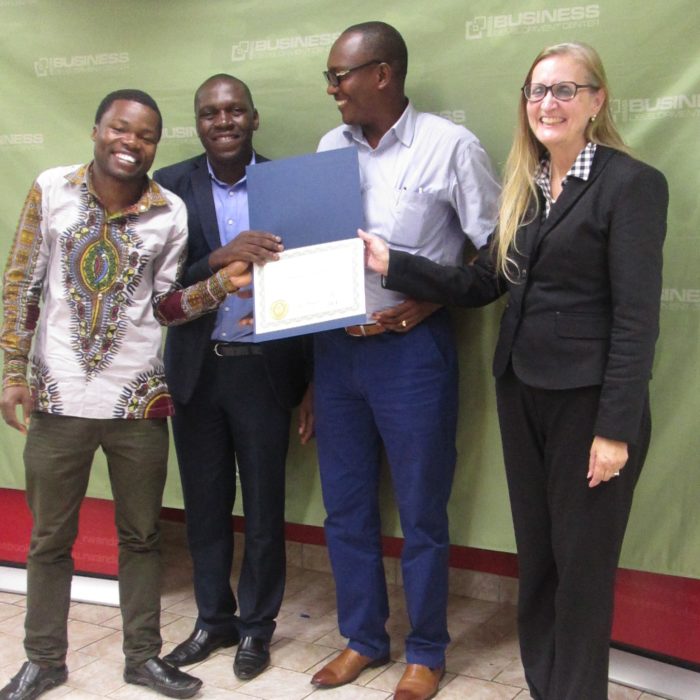
Mr. Emmanuel Nturanyenabo (first left), receiving his certificate from the Rwanda Business Development Center (BDC Rwanda) where he developed his company, Teebah Film Village.

For this year’s edition, more than 150,000 Africans from 114 countries worldwide applied to join the 4th cycle of The Tony Elumelu Foundation’s (TEF) 10-year, $100 million TEF Entrepreneurship Programme. On, the Foundation announced the African entrepreneurs with the most innovative, high-potential business ideas. Recently, Tony Elumelu announced his selection of 1000 winners, including our entrepreneur, Mr. Emmanuel Nturanyenabo, who wins this highly-coveted fellowship with his Teebah Film Village. Joining this program will help Emmanuel to access top-notch mentorship, coupled with a 12-weeks training and networking with world-class entrepreneurs; and an added opportunity to access seed-funding.

Tony Elumelu (Center) announcing the 2018 TEEP Winners

More information about the Tony Elumelu Foundation and and the exclusive list of the 2018 selected entrepreneurs can be accessed on the organization’s official website: http://www.tonyelumelufoundation.org/

We congratulate Mr. Emmanuel Nturanyenabo and his company, Teebah Film Village for being among the few entrepreneurs selected to join the 2018 Tony Elomelu Entrepreneurship Programme. BDC Rwanda is proud of you as our very own graduate.


Seven ways men can escape poverty

Seven ways men can escape poverty

1. Get the right woman:
Forget the slay queens and women with looks but zero brains. Get a woman who will not only support your vision but will also push you to achieve more. A woman who will inspire you to work hard and not a woman who just makes you hard. He who finds a real woman finds a good thing and obtains favour and power to create wealth.

2. Stop Taking Cheap Drinks:
I have no problem with having drinks during social interaction and networking. However, when you drink cheap drinks or drink in cheap places, you hang out with cheap people who have cheap ideas and a cheap future. Big business opportunities are found in places where the drinks are expensive. In fact, in places where they sell cheap drinks, the only people you will find there are people who will be asking you for money. They even clap when you come knowing ‘big buyer’ has come.

3. Stop being Lazy:
“Man ooh Man, why art thou Lazy?” You are too lazy for your own good. You sleep the whole day and blame the government for your poverty. “A Little Sleep, a Little Slumber, poverty shall overtake you like a political cadre in overalls”. A lot of men are just lazy when it comes to making money. They have enough energy to give a woman five orgasms, but have no energy to start one organization, that’s why it is so easy for men to manufacture children than it is to make even pegs for putting children’s clothes on the line..

4. Know Productive Things:
If you keep too much junk in your head, you get a junk life. I know a lot of men who are so sharp when you are talking about girls, about soccer and about street politics, Who is Rich who is not,Who has a good house but you can’t bring a topic about investment, innovation and business, they start looking at their phone, yawning or saying bye.. Useless things, videos and memes go viral fast than constructive things.. A man must know how to do at least one productive thing (have one skill) even without having gone to college.

5. Get Connected to Big Men Who are better than you :
A lot of men are failing because they are not mentored. They don’t have anyone to whom they can sit down and listen, with obedience. In the old days, old men would sit young men down and show them how to hunt and kill animals… and no man was considered a man enough until he has personally killed an animal… now these men of nowadays are not mentored and can’t even kill a bird. There are men out there who have made it in life, find a way to get mentored by big men who are making waves and impacting people in our community.

6. Learn how to make money

The main objective of the education we have all inherited from the colonialist was and  is still to create jobs seekers and poor employees who will never think of creating jobs.  If you want to get our out poverty, you need learn in different style. There are good training centers like Rwanda Business Development Center  where most of the graduates started their businesses. 

7. Work:
Stop Spending your whole day just praying and fasting yet you know that the Bible tells you that God will bless the work of your hands. Yes yes The blessing finds you on your way doing something,Stop using Prayer as an excuse not to work.

Money mistakes you should never make

*Money Mistake 1* 
Never borrow money that accrues interest to start a business . That is to say, never borrow money to start a business expecting that the business will generate income to pay back the borrowed money plus the interest.
*Money Mistake 2
Never spend money you haven’t received. Don’t even promise someone money based on a promise you have from someone else. If someone tells you: “Ezra, come to my office tomorrow at 9am and pick #30K”don’t go out to buy items on credit based on this promise, with the hope that you will pay off your creditor when the promised money comes; it may not come as promised and this will leave you in problems with your creditors.
Money Mistakes 3
If you want to save, whenever you receive money, don’t start spending hoping that you’ll save what remains. Normally what remains is zero because as long as money to spend is available, the numerous things you can spend it on are also available. And things to spend on even incite their ‘relatives’ so that you spend even more than you had planned. When money to spend is not available, we naturally find a way of doing without it. That’s why I’ve learnt to save with an INVESTMENT CLUB. Once I send money there I assume I no longer have it. Before you spend any money, put your savings aside then spend what is left after saving.
*Money Mistake 4*
When you get an opportunity to meet a very wealthy person, never ask for money. Ask for ideas on how to make money. They may even choose to give you money on their own after seeing that your ideas are great, but let getting money from them never be your objective.
*Money Mistake 5* 
Keeping your seed instead of planting it. Many people stop at saving. It’s very, very difficult to save and have all you need to maintain your lifestyle especially after retirement. When you save, your savings are seed; plant it. When you just keep the seed (saving money) some seeds begin to die (eaten by inflation and the like). That’s why I recommend that you read about the different types of investment vehicles you can use to grow your savings. I am not necessarily talking about putting the money in a business, because you can easily lose money in  business. I am talking about putting it in an investment.
*Money Mistake 6*
Never lend someone money you are not willing to lose. By the time you lend someone money, be contented in your heart that should the person fail to pay, you will not die. You should not even lose that person’s friendship if they fail to repay the money you lent them. If you feel the person might fail to pay you and this will not affect your relationship with them, then lend them money. If their failure to pay would make you hate this person’s entire clan, please advise the person to go to the bank.
*Money Mistake 7* 
Never append your signature to guarantee someone on a financial matter if you are not willing or able to pay the money on their behalf. Do I have to explain that one? No, it’s self-explanatory.
*Money Mistake 8*
Avoid keeping money you don’t intend to use in the short-term within easy reach. For instance, don’t walk with #100K in your pocket when all you plan to do in a day costs #20K. Like I mentioned in Money Mistake 3, there are always expenses available to gobble any money that is within reach, so if you don’t want to lose it, put it away in a safe place.
*Money Mistake 9*
Avoid keeping money in inappropriate places e.g. in socks, under the pillow, in a pit, in the sitting room, in the bra, in a travel bag that you will place somewhere in a bus … impulse buying is a devil that will keep you busy!
*Money Mistake 10*
Spending money on an item that you can do without (at least for the time being). These days when I pick money from my pocket or wallet, before paying for something I ask myself: What would happen if I didn’t buy this? If I find I can live with the consequences of not having that thing, I smile and walk away.
*Money Mistake 11* 
Paying an amount for something that’s not the minimum you can get that same value for. In other words, if you are along east Legon road and you pay #5K for a shoe that you can get at #3K at Makola  market, that’s a money mistake except for those who have achieved financial freedom.
*Money Mistake 12:*
Consistently spending all you earn or more than you earn. It’s like having a drum where you have an inlet that’s smaller than the outlet. It will never get full. And should the inlet ever reduce significantly the drum will run dry. If you do it the other way round and the inlet is bigger, it will get full and even overflow. Hence, we have to always ensure we are widening the inlet while narrowing the outlet – all the time. Your side hustle comes in handy!
*Money Mistake 13:*
Thinking about short-term only and forgetting about long-term or thinking about the long-term and forgetting about the short-term. For instance, Lydia was told that there’s money in land. She saved money over a long period of time and bought 30 acres of land. Now she has the land but she is always broke. She is always complaining. She’s disgruntled and she doesn’t seem to see herself earning from the land in the near future. Now, let’s ask ourselves: Having 30 acres of land and no money to feed your family or take a child to hospital, is that wealth or poverty? I think Lydia only looked at long-term needs and forgot that she has short-term needs that require money. What of those who find they are one paycheck away from salary? Are they thinking about the long-term needs?
Let’s take stock of our finances. How many mistakes are you guilty of? Do you now feel better-equipped to do better with these tips? Good luck, savers! Share this knowledge with your friends because it will not benefit you if you are selfish with it.

PRIORITIZATION AND TIME MANAGEMENT: HOW TO OPTIMIZE YOUR DAY TO ACHIEVE BETTER WORK-LIFE BALANCE

Whether you’re an entry-level worker or an executive near the top of the organizational chart, you might feel as though you devote far more time to work than you do to your family, friends, hobbies, or personal interests. While there are a variety of approaches you can take to gain more work-life balance, much of the problem stems from inefficient time management. By implementing these prioritization and time-management tactics, you’ll find that you have more time to spend on the activities that feed your soul without sacrificing important career demands.

Embrace the Power of Prioritization

As a busy professional, you must develop a way to prioritize your tasks that works for you. Simply making a task list without any system for prioritizing tasks will leave you feeling frazzled and overwhelmed.

Evaluate your to-do list and think about the single most important thing to achieve that day. Many time management experts suggest the 1-3-5 method: choose one major priority, three medium-sized tasks, and at most five smaller tasks to prioritize each day. If you try to prioritize 10 or 12 major, time-consuming tasks each day, you’ll find that you’re not getting things done. Instead, prioritize the tasks that are truly the most important and the most urgent, and focus your energy and attention on crossing those items off your list.

Scheduling Takes Prioritization to the Next Level

Make your most important task your top priority and schedule adequate time in your calendar to focus on it. Schedule some time to work on your second and third most important tasks as well. If you end up finishing your top three priorities, you can fill up remaining time with your fourth and fifth priorities.

It’s important that you allow adequate time to work on each task, as well. Allotting yourself an hour to finish a report that will likely take three hours to complete won’t cut it. It is, however, acceptable to schedule a few different blocks of time over the course of several days, or even a set amount of time each week for longer-term projects that become monotonous if you try to do them all at once.

Avoid Multi-Tasking

One major benefit of prioritizing and scheduling your time is that it reduces your tendency to attempt multi-tasking, which experts say doesn’t really work. What actually happens when you try to multi-task is that you end up wasting valuable time from a phenomenon called context switching.

The idea behind context switching is that it takes your mind a few minutes (or longer) to get back up to speed with where you last left off on a project or task, because you switched your focus to something else. In fact, it’s estimated that it takes an average of 25 minutes to adequately resume a task after an interruption or context switch. Imagine the hours wasted when you switch back and forth between tasks dozens of times per day. No wonder you feel like you never get anything done!

It doesn’t matter where you fall in the organizational chart; it’s important to have some balance between your work and personal lives. Work-life balance is all about having time left at the end of the day – or time away from work, whenever that may be – to spend quality time with your family and friends and participate in activities that feed your soul. When you implement better systems to manage your time and avoid wasting time due to context switching, you’ll find that even though you still have just 24 hours in a day, it feels like you have more time to do the things you enjoy.

FOR MORE LIFE AND CAREER TIPS FROM A CERTIFIED COACH, YOU CAN CONNECT WITH JULIE ON HER WEBSITE.
IMAGE VIA PIXABAY BY THE PIXELMAN

Source:http://regententrepreneur.org

We always love to share incredible stories of our graduates who are changing the nation of Rwanda and the World through doing business from the heart. Today, we propose you to meet an exceptional BDC graduate and young entrepreneur, Yvette Ishimwe.

In December 2016, Yvette graduated from the 17th cohort of our 14-week World-class Entrepreneurial Action-Learning Program certified by Regent University (USA) and run by the Rwanda Business Development Center (BDC). While at the BDC, her passion for solving real-life challenges in her community led her to develop a life-changing business that she called “Iriba Clean Water Delivery Ltd”. Today, this project is greatly contributing to the betterment of life of communities in the Eastern Province of Rwanda through increased access to clean water, at an affordable price, something that residents of this water-scarce area had never dreamed even once in their lives.

Photo: Yvette Ishimwe posing for a picture during her graduation from the Rwanda Business Development Center (BDC)

This year, 20-year-old Yvette Ishimwe was one of the only two lucky winners from Rwanda selected to receive the highly-coveted “Queen’s Young Leaders Award” awarded to her by Her Majesty Queen Elizabeth II at Buckingham Palace, London.

“I was lucky to be among the winners because they realised that my project has the potential to impact my community, and the award became a fuelling force that encouraged me to do more for my community and country at large as a leader, to work even harder and transform people’s lives” 

– Yette Ishimwe tells the New Times in an exclusive interview on August 31, 2017

The award celebrates inspiring young people from all over the Commonwealth that are dedicated to driving change in their communities and beyond. Ishimwe was recognised by Queen Elizabeth for her work that includes reducing the burden on women and children through improving access to safe water.

Yvette Ishimwe meets Queen Elizabeth. Left: Ishimwe’s project offers authentic innovative solutions to water scarcity. Courtesy photos

To learn more about Yvette’s business and her entrepreneurial journey, we encourage you to read her full transcript of her exclusive interview with The New Times about what the award means to her and how she intends to continue to impact lives. Here is the article featuring Yvette’s full interview.

Yvette’s story can be your story! If you want to impact your nation through business, the Rwanda Business Development Center (BDC) has a place for you. We are committed to nurturing entrepreneurs like you to build successful businesses through world-class training and support with mentoring and coaching, connections and access to capital. Applications are now OPEN for the next intake of our World-class Entrepreneurial Action-Learning Program to begin in mid-November 2017. Click here and Apply Today!